What Are They?
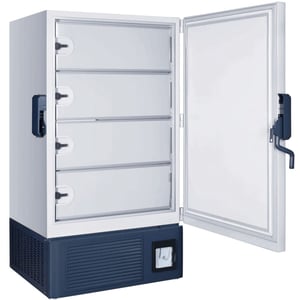
Ultra-Low Freezers or ULT typically have a temperature of -45C to -86C. These are also known as minus 80 freezers.
These types of freezers are used in medical research, blood banks, hospitals, epidemic prevention services, and research institutes in order to protect samples such as virus’, bacteria, eukaryotic cells, blood, and semen.
How Much Can A ULT Freezer Hold?
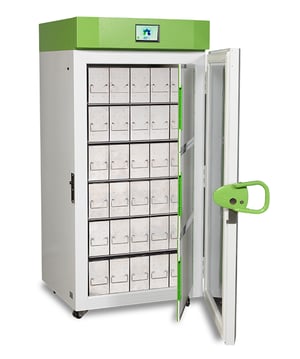
These freezers come in upright and chest models in order to maximize storage capacity to accommodate a variety of laboratory footprint requirements. An ULT Freezers inner volume is usually in between 300 and 800 L. At full capacity, 40,000 or 50,000 microtubes can be stored in one unit. Since these ultra low temperature freezers have max storage capacity, they increase the rink of a power outage causing mass loss in money.
Why Backup Power Systems Are Necessary for ULT Freezers:
Ultra-Low Freezers are dependent on their reliability to keep these samples safe. Some of these samples are irreplaceable and in the event of a power outage these samples and years of hard work and research could be lost. While ULT freezers use compressors and intermediate systems in order to keep your samples safe while the power is on, they cannot do their job in the event of a power outage. In these cases, the ULT freezer can only hold the cold until the power returns, but what if it never lost power even when electricity to the building does? Medi-Products can help keep all of your medical research and advancements safe even when the electricity goes out.
How Much Energy Does A ULT Freezer Use?
These special freezers, since they must produce such low temperatures, consume high amounts of electrical energy per day. Depending on the volume of the freezer, the consumption starts at 11 kWh/day.
A Colorado college did a study documenting the data gathered in energy consumptions from 11 different ULT Freezers on campus ranging from less than a year old to twenty years old. The energy consumed varied from 15kWh/day to 32kWH/day. This turned to an average consumption per year of 3,233 (kWh) to 6,205(kWh).https://www.colorado.edu/ecenter/sites/default/files/attached-files/ucr_ult_tests_report_-_2016_final_df1.pdf
How Does This Affect Our Systems?
Since these systems use so much electricity, this requires a larger battery backup unit with the ability to handle this extensive amount of power.
Learn More About Battery Backup Power!
To answer even more of your questions and find additional solutions to problems that could affect your medical facility or laboratory, check out these other articles from the Medi-Products blog and the Medi-Products Learning Center:
How Much Time Can a Battery Generator Can Run For?
How Much Power Do I Need to Meet Accreditation Standards?
Meeting Recommended Standards and Requirements and for VFC, CDC and NSF456.