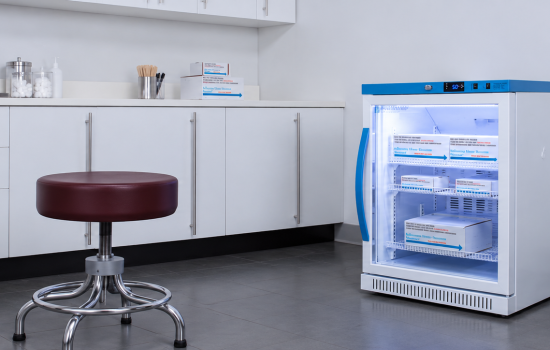
VFC providers must comply with specific requirements and activities relating to the storage and handling of vaccines. Appropriate actions of these requirements depend on the correct equipment, conforming to policies that are implemented by the state, and keeping up to date on your vaccine temperatures. Failure to comply with these can result in millions of dollars worth of vaccines being lost.
Storage Units
According to health.ny.gov, New York State VFC providers must use stand-alone refrigerator and freezer units to store vaccines, effective by January 1st, 2020. The temperature of the freezer must be between -58°F and +5°F (-50°C and -15°C), while the refrigerators must be able to stay between 35°F and 46°F (2°C and 8°C). dph.georgia.gov has a checklist of general vaccine storage unit recommendations that should be followed by a VFC provider.
General Vaccine Storage Unit Recommendations
- Maintain required vaccine storage temperatures: Refrigerators: between 35°F and 46°F (2°C and 8°C), Freezers: between -58°F and +5°F (-50°C and -15°C)
- Frost-free or preferably have an automatic defrost cycle. If a manual defrost is used, the provider should be diligent in periodic defrosting according to manufacturer recommendations or if there is a 2 inch or greater ice buildup in the freezer. Ice buildup in the freezer will diminish the equipment’s capability to maintain correct storage temperatures. Even manual defrost combination refrigerator/freezers cycle. Cycling can affect storage unit temperatures.
- Have enough room to store the year’s largest inventory and accommodate preferred method of storing vaccines by funding split without crowding.
- Have enough room to store water bottles (in the refrigerator) and frozen coolant packs (in the freezer) to stabilize the temperatures and minimize temperature excursions that can impact vaccine potency
- Have a calibrated thermometer with a current Certificate of Calibration and Traceability inside each storage unit.
- Reliably maintain the appropriate vaccine storage temperatures year-round
- Dedicated to the storage of vaccines. Food and beverages should NOT be stored in a vaccine storage unit
- Vaccine storage unit door must close securely and tightly against the unit. There should be no gaps between the seal and the body of the unit when the door is closed.
Temperature Monitoring and Data Loggers
According to the Centers for Disease Control and Prevention, all VFC providers must have temperature monitoring devices in each storage unit that will continually show the active temperature and have a downloadable log. They must also have a pre-calibrated backup device in case their first one becomes unusable.
Unit Sizing
The size of your office will affect the sizing of your unit. Your office size is calculated by the amount of doses your office produces in a year.
| Office Size | Required Equipment |
| Low Volume – less than 500 doses/year | |
| Very High Volume 10,000 doses/year | Pharmacy-grade or biologic-grade refrigerator-only units and stand-alone freezer units |
| High Volume – 2,000-10,000 doses/year | Refrigerator-only (16.7 cubic feet minimum) and stand-alone freezer units |
| Medium Volume – 2,000 doses/year | Refrigerator-only (16.7 cubic feet minimum) and stand-alone freezer units OR Pharmacy-grade OR biologic-grade under the counter units. |
Backup Power
Thousands of dollars of vaccines are getting lost each year from power outages. This waste can be eliminated by installing a battery backup system that will support the vaccine refrigerator. A practice that has a high-volume refrigerator, that stores 10,000 doses per year, and restocks each quarter, can easily be holding up to $ 54,000 of vaccines, at an average of about $ 16.00 per With the over stressed infrastructure, we currently have in the United States, power outages are becoming more and more common, this ever increases the likelihood of this loss. Refrigerators can be supported either by installing a fuel powered generator or a battery backup system.
Learn More About Battery Backup Power
To answer even more of your questions and find additional solutions to problems that could affect your medical facility or laboratory, check out these other articles from the Medi-Products blog and the Medi-Products Learning Center
VFC Temperature Data Logger Requirements & Manufacturers