Why Is Testing a Rechargeable Generator Important?
One of the biggest advantages of a battery-based backup power system is how little upkeep it requires, thanks to its:
- Solid-state electrical components
- Sealed lead-acid AGM (Absorbent Glass Mat) batteries
- Durable powder-coated or stainless-steel enclosures
Thanks to these features, EverSafe battery backup generators offer:
- Instantaneous power delivery
- Long-term, efficient energy storage
- Exceptional durability
Nonetheless, instituting a consistent testing routine remains essential. Regular testing confirms that your backup power source:
- Operates as intended
- Can deliver its rated runtime
- Allows you to detect and resolve any issues promptly
We suggest two testing intervals: a weekly function check and a monthly run-time assessment. These tests verify that your system switches to battery power (inverts) and can sustain operation as expected.
How to Test a Battery Generator
Periodic testing guarantees your system performs reliably and fully utilizes its battery capacity. It also helps uncover any potential issues early, reducing possible downtime. We recommend completing both weekly and monthly checks as outlined below:
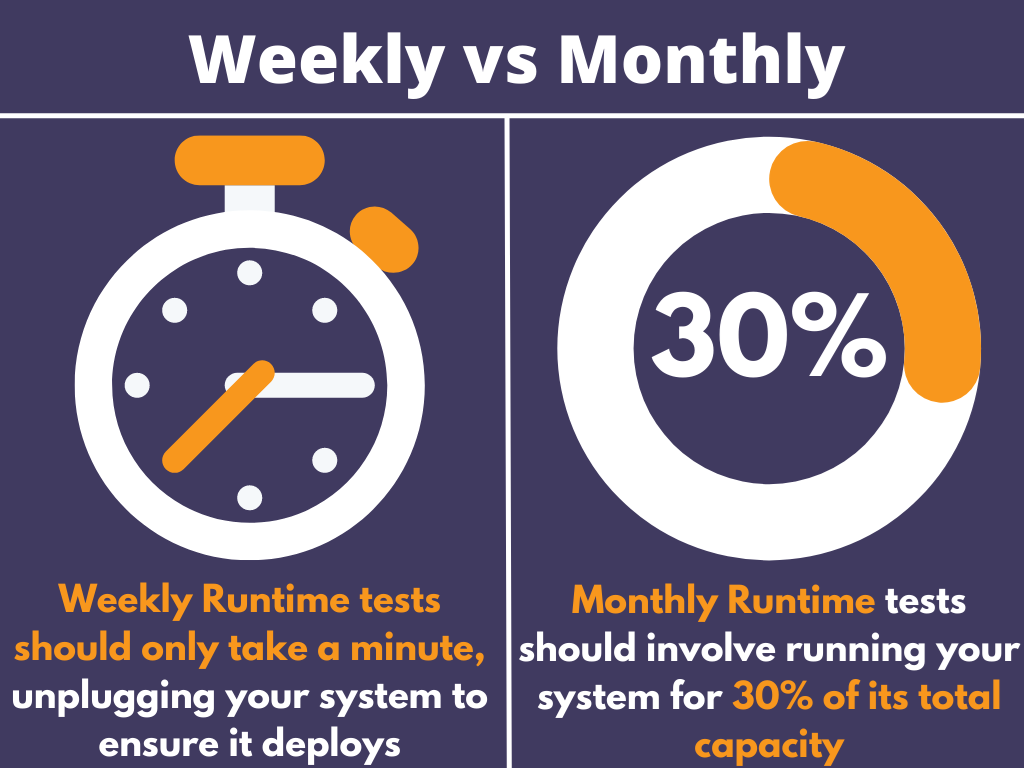
Weekly Function Test
This quick test, which takes only a few minutes, confirms that your system will activate during a power failure. To carry it out:
- Disconnect the unit from AC power—either unplug it (for stand-alone or mobile units) or turn off its dedicated circuit breaker (for hard-wired systems).
- Watch the LED control panel: it should shift from “charging” mode to “inverting” mode, indicating that the system is now supplying power from its batteries.
Once confirmed, reconnect the power (or turn the breaker back on). Your system should resume its charging cycle—typically returning to float or bulk charging mode.
Monthly Runtime Test
This test helps cycle your batteries and verifies that your system has sufficient capacity to sustain connected loads.
To begin:
- Again, disconnect from AC power—either by unplugging or switching off the breaker.
- Confirm via the LED panel that the system switches to “inverting” mode.
Then, allow the system to run on battery for up to 30% of its specified runtime, or 2 hours, whichever duration is shorter.
- For instance, a 100-hour unit would only need a 2-hour test (not 30 hours).
- A 5-hour unit would undergo a 90-minute runtime test.
It’s best to have a trained person oversee the system throughout the test to ensure safety and to respond quickly if any issues arise.
Generator Testing Resources
We’ve compiled helpful resources to support your testing and maintenance efforts, including: